What Actually Happens In Between Bands At A Festival
One band walks offstage. A few moments later, the next one walks on. Backstage, it’s all about space, time, and making the impossible look routine. Welcome to the world of the changeover.

I’ve already covered what happens over 24 hours on a Main Stage, but one of the questions I get asked most is:
“How the hell do festivals get so many bands on and off stage so quickly?”
The answer is always the same, it’s about Space and time, and the lack of both.
Before diving straight into the enormous headline-level productions with moving stages, pyro, video walls and enough trucks to make you think Red Bull are about to attempt a Guinness Book Of Records motorbike jump backstage, let’s relax a bit, and start smaller.
Much, much smaller, in a tent, named ‘Stage 4’, and a band playing their first ever festival.
The band are called Intrinsic Flaw, they are currently a 4-piece that play classic British indie rock.
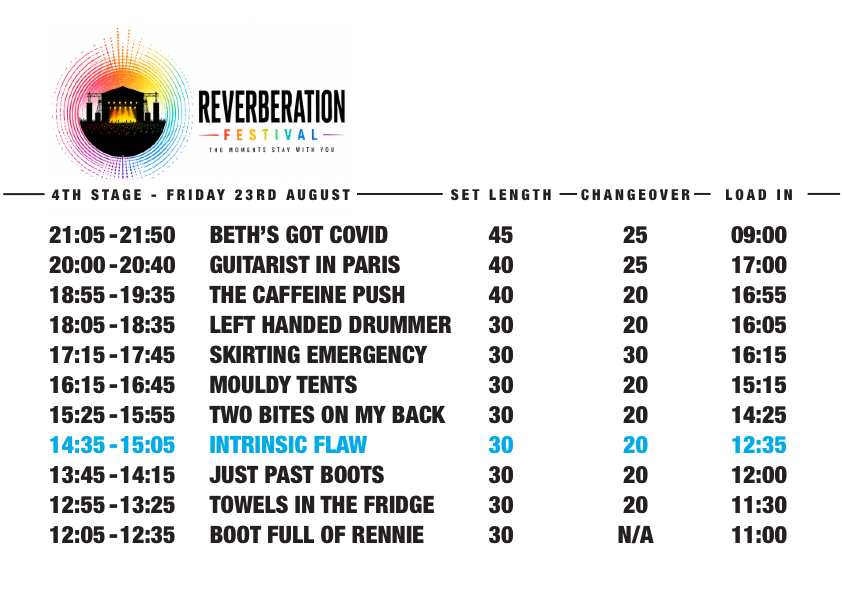
They are 4th on stage, on the 4th stage at a major UK music festival that I’ve made up, called Reverberation.

The band arrive on site in a small, smelly van, driven by their mate Dan, a future tour manager - but he doesn’t know that yet, he’s just helping his mates, and they are all having a laugh.
A 4-piece means they consist of a Guitarist, a Bass player, a drummer and a lead singer. They all met at school, decided not to go to university and focused on songwriting and learning their craft, and it’s starting to pay off.
But this little gang consists of 6. Yup, the Lead Singer’s ever-present girlfriend, who wisely sits shotgun, next to Dan the driver, away from the band, who are bouncing around in the back amongst guitar cases, meal deals and the lingering whiff of petrol mixed with farts.
Now, before you ask, yes, the festival name is made up, so are all the band names.
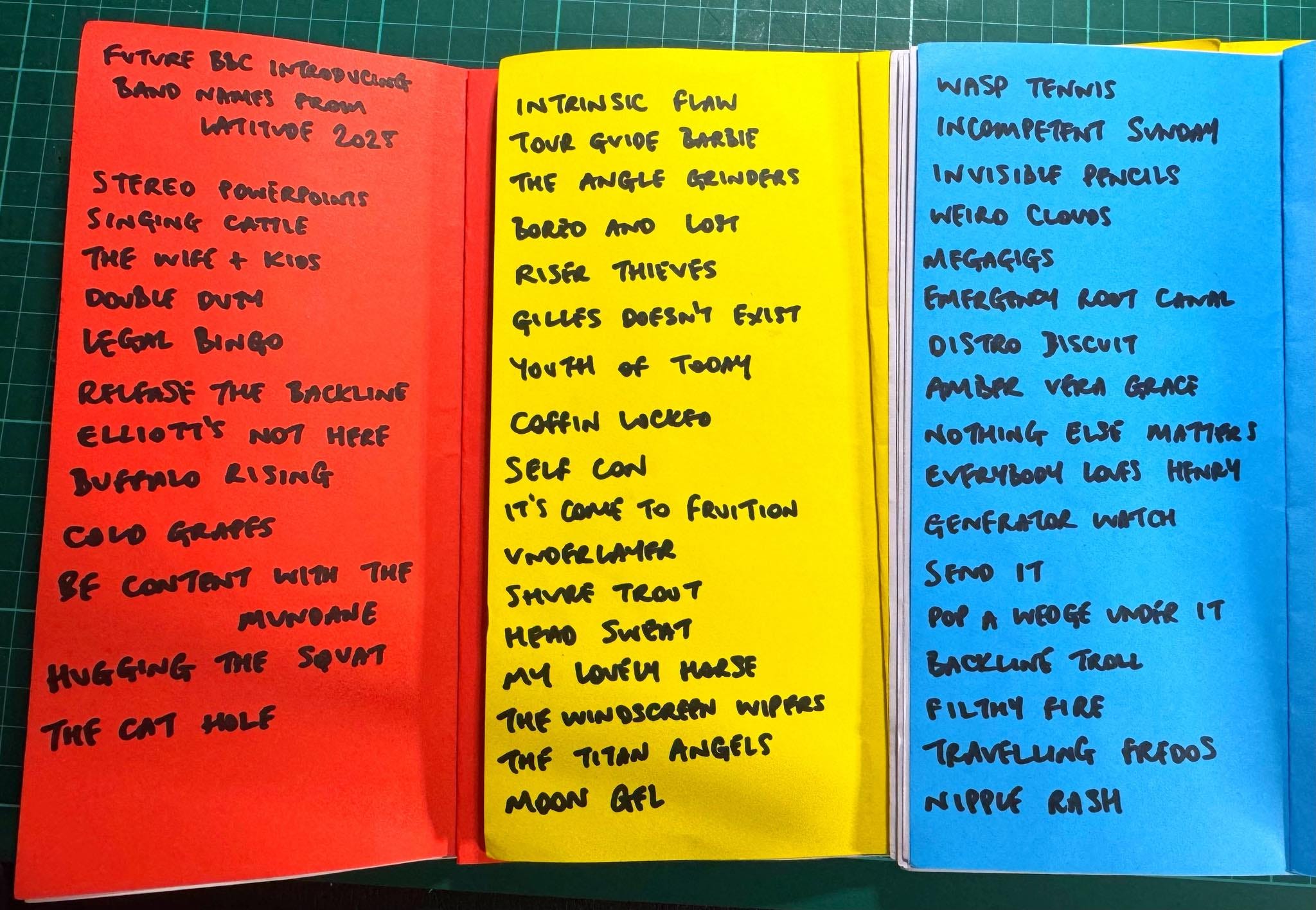
Inspired by Bob Mortimer’s Cat Name Auction, I’ve been collecting names for Future BBC Introducing Bands, and anyone stuck for a name are free to use one. To make the list, the name must be genuinely overheard in natural conversations whilst on site; they are not ‘Oh I’ve got a good band name for you!’.
Off on a tangent again, apologies, back to the rise of Intrinsic Flaw (name captured at Latitude Festival 2025)
All bands on stage 4 are expected to share the festival-provided backline from John Henry’s, which means the Bass & Guitar Amps, and the Drum Kit.
They are allowed to use their own amp heads, amps, drum hardware (cymbals) and other smaller bits, but nothing else, and they have all agreed in the production advance that they will do this.
Why can’t they use all their own stuff?
Because of Space and Time, never enough space, and there’s never enough time. Again, and always.
Smaller festival stages are basically an organised compromise. Bands at this point in their career expect everything, but have no idea how everything works or what everything is, but think they have to demand everything anyway; they’ll learn…
Every band has broadly the same setup, which means most of the microphones and cabling can stay in place all day.
That saves a huge amount of time during the changeover, trust me, time disappears frighteningly quickly backstage.
And there’s no space to move big things around, especially the drum kit, which will sit centre stage at the back, on a static platform called a riser.
This is where it could get complicated and nerdy, but to simplify it, each ‘thing’ on stage that needs to be heard by the audience either needs a microphone or a line. Eg: Vocals. Guitar. Bass. But the drum kit needs more microphones, for each bit of the kit. A keyboard might be plugged directly into the system without an Amp, via a box called a DI (direct input). Each of these Mics or inputs, can be individually controlled by the audio desks;
• What the audience hears, controlled at front of house (what folks call the Sound Tower)
• What the band hears on stage, controlled side of the stage, so that each member can turn up or turn down the noise from the other members.
And yes, the singer always wants more of themselves in the monitor mix. This is one of the early warning signs of Lead Singer Syndrome, a condition that unfortunately worsens with success.
All of these mics/lines have to work before the band walks onstage, so on smaller stages, the less changes you make, the easier it is to switch between artists, and they are tested in what’s called a “line check” in every single changeover, the bit in-between the artists performance, when you see people dressed in black moving stuff whilst sweating, shouting and scratching their heads.
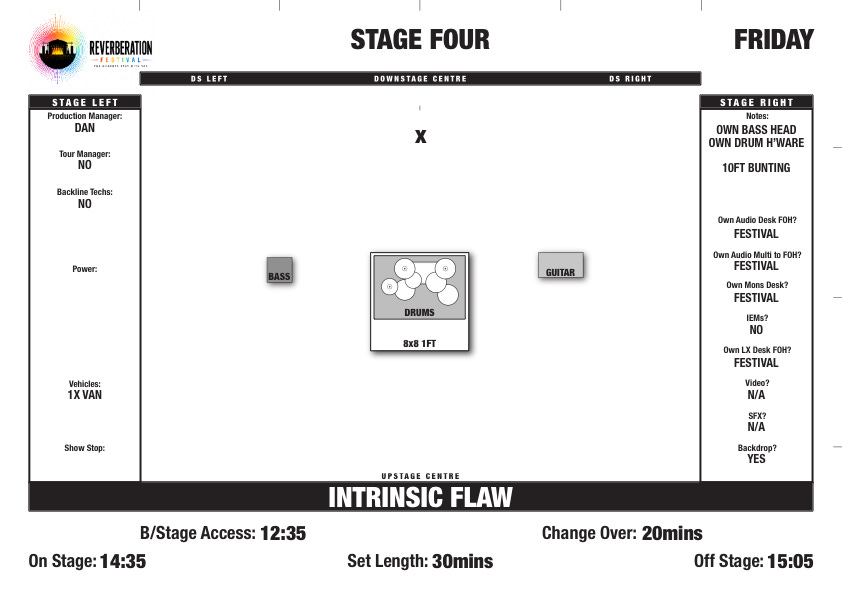
Intrinsic Flaw have brought
- two electric guitars,
- one bass guitar,
- an acoustic guitar
- an Ampeg bass head.
They will use the festival-provided Fender guitar amp and Amp speaker. The drummer has brought some drum hardware, but wants to see the house kit, because it’s probably better than what he’s got.
Oh, the band also brought
- some bunting, to give the set-up a personal touch
- a bedsheet made into a backdrop, painted by the lead singer’s girlfriend (not shown)
Notice that all the heavy stuff, including the drum kit, are on wheels. That’s because at Festivals, if it doesn’t roll, someone’s got to lift it, and that can be knackering.
The drum kit is on a raised wheeled platform - this is called a rolling riser. This is so, should the band want to move some of the items on stage to suit them, they can easily.
The drum riser, as it’s called, is normally 8ft x 8ft. (Yes, I’m based in the UK, and we use feet as well as metres), and made up of two 8ft x 4ft boards, on wheels, and joined down the middle. This is extremely handy, as most stages are also built from 8ft x 4ft stage decks, so you can easily see and calculate how much space there is to move stuff around, just by glaring at the floor.
It’s a bit like loud, sweaty Tetris racing against the clock. Sweaty Tetris, that’s one for the Future BBC Introducing Band Names.
Here’s a shot of the Stage Four stage directly overhead, the rectangles are the stage boards, 8x4, the yellow square represents this 8x8 drum riser, the green area the performance space, and the red area, the backstage working area. Probably just enough space to swing a cat back there.
Here’s my one-sheet of all the details agreed in advance, including the band’s stage plot.
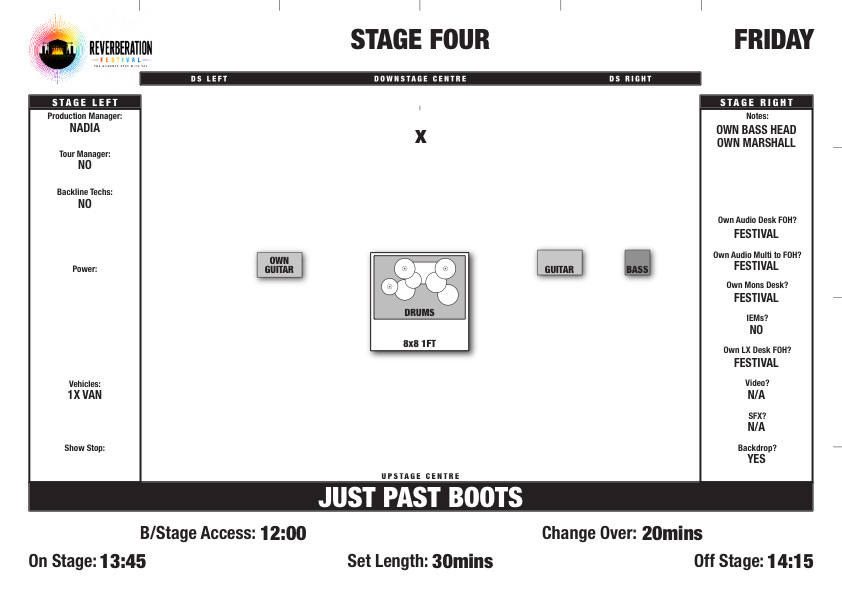
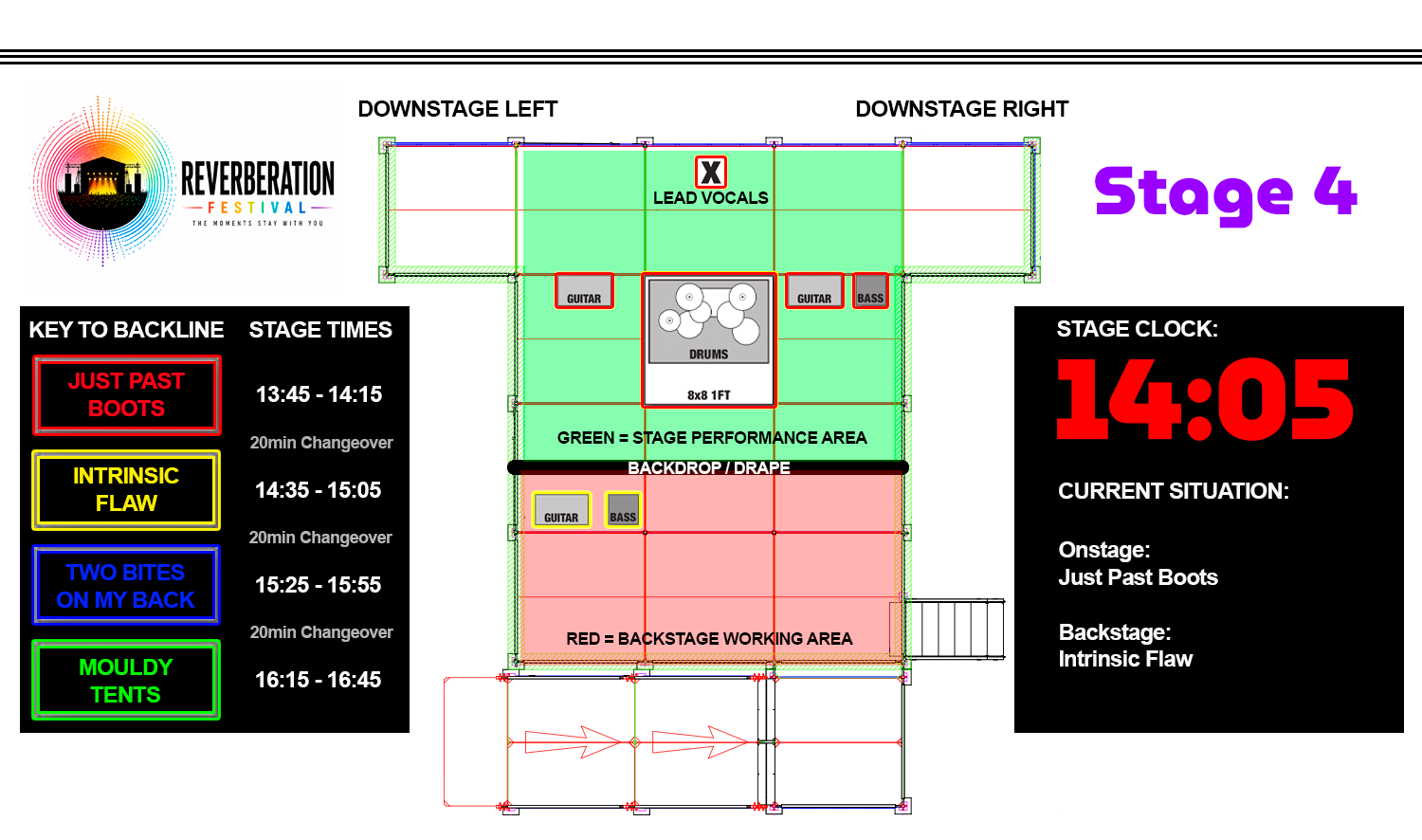
The band on before Intrinsic Flaw are Just Past Boots, they have a similar set-up, but are using an additional guitar amp, and their own Ampeg head (bass)
The band on after Intrinsic Flaw are Two Bites On My Back, again nothing complicated, but the Lead singer has a floor tom (please kill me), and they have a small keyboard set up, stage left.
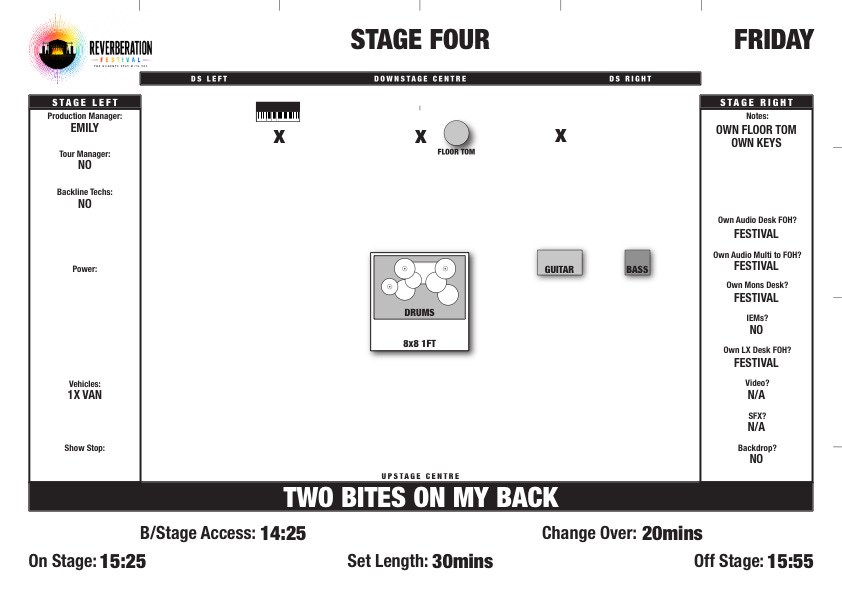
And this is how this simple changeover takes place.
The clock is ticking. It literally is, as a cheap office-type analogue clock with a battery that often falls out, but that’s not the point; it’s completely pointless because no one under the age of 25 can tell the time.
It’s 14:05 by everyone’s mobiles, and Just Past Boots are on stage performing, Intrinsic Flaw have loaded in, tuned up and are waiting backstage, the atmosphere is slightly different, less messing about laughing, more pacing and less fingernails.
Two Bites (as their fans call them) have arrived early, the floor tom carried up to the backstage area wrapped in a blanket, like a precious firstborn leaving the maternity ward. Only this will be beaten furiously with a drumstick in front of 3000 people in about an hour, maybe I should have left that simile out.
The Stage Manager checks his phone for the time, again, and signals to the Just Past Boots that they have 10minutes left.
At 14:15, bang on time, Just Past Boots take their applause, and leave stage, taking their instruments and drinks with them. The Stage Manager indicates to the stage crew to help, as it’s now it’s time for Intrinsic Flaw to move the stuff on stage they want, and check it before they play.
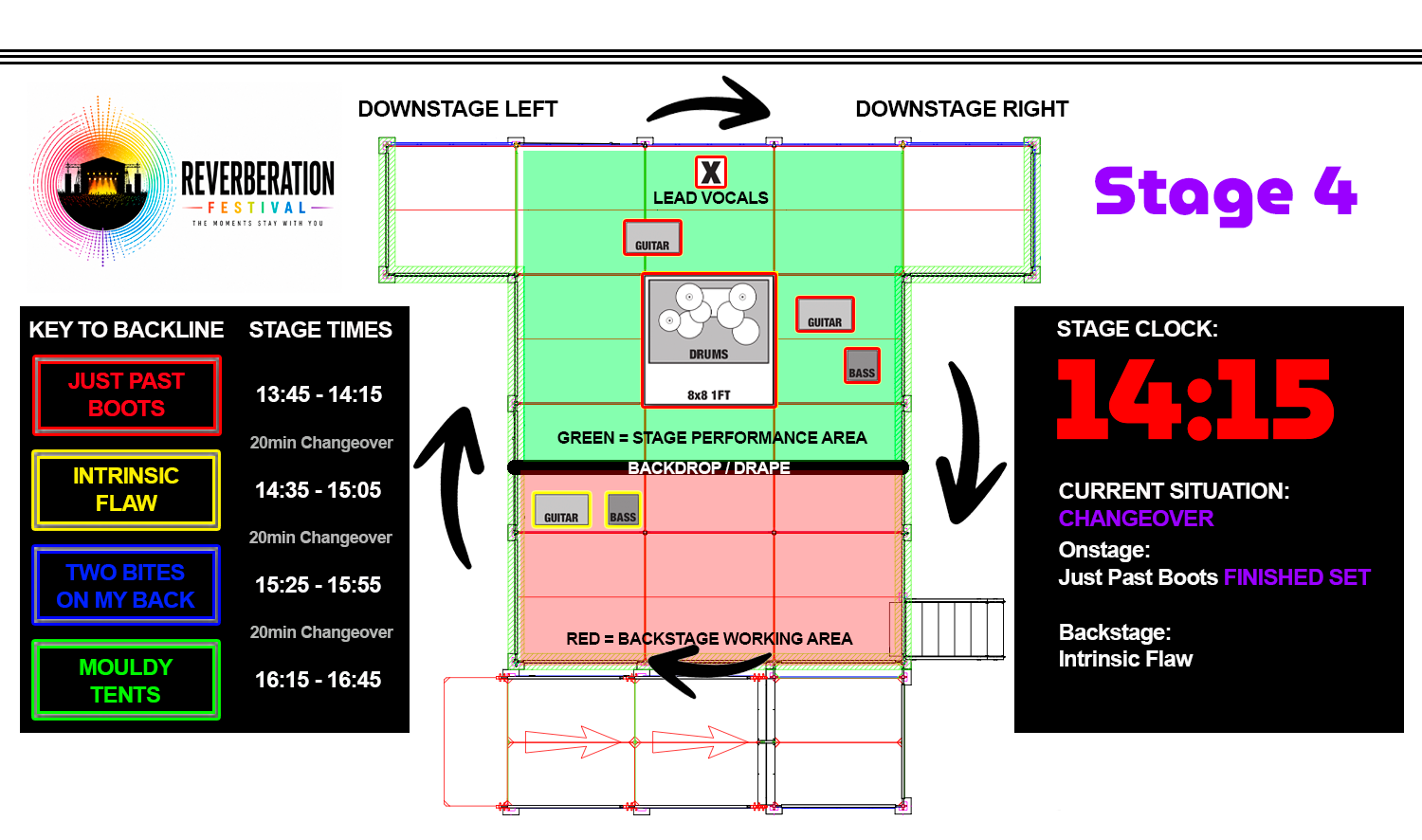
Dan the van driver is helping the drummer with the cymbals, the bass player adds his bass head to the top of the bass cabinet, and the guitar player is strategically stringing the bunting.
Their bedsheet backdrop is being hung up behind them on a long piece of scaffolding, hung each end with climbing rope by the lighting team, all under the watchful eye of the Stage Manager who is keeping a close eye on the clock.
There’s only 20mins to do this changeover, and again, bands at this point in their career expect everything, but have no idea how everything works or what everything is, but think they have to demand everything anyway; this isn’t an easy job for a Stage Managers on smaller stages like this one, stage 4 compared to bigger stages, just different challenges, but this is where you earn your stripes…
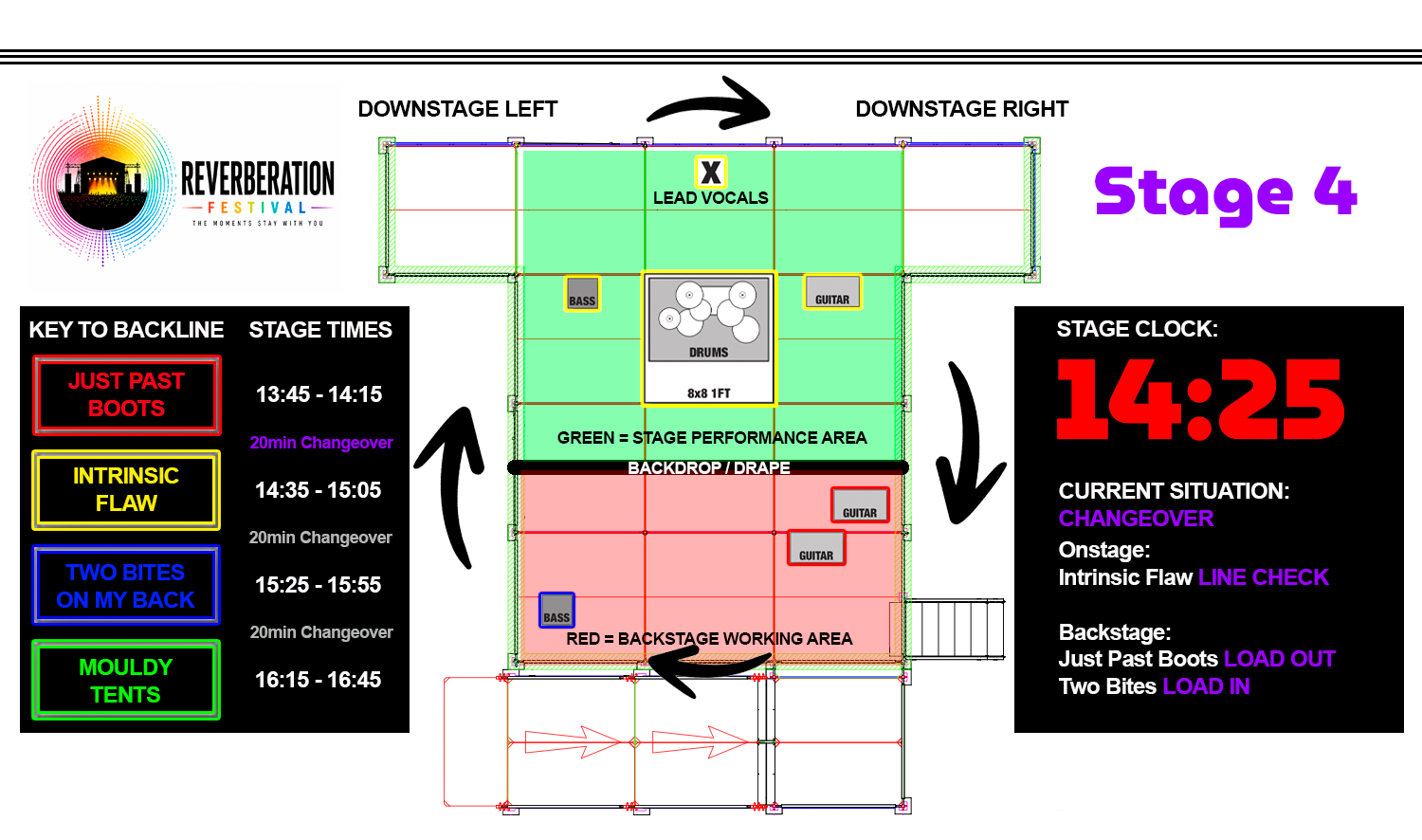
Meanwhile, Intrinsic Flaw’s lead singer is still backstage with his girlfriend, chatting to BBC Radio One’s Jack Saunders, who has just appeared to see the band with his radio producer and a couple of other folks. He tells them he’s heard great things, can’t wait to see them, and wishes them luck.
Everything is line-checked, the festival audio team are happy, the stage monitor engineer tells the band to just wave at her, point to what they want, then up or down for the volume. There’s no time for a monitor mix pre-show on this stage. Intrinsic Flaw don’t know what that is - they’ve only ever played through their own amps.
The Stage Manager does a final round of checks to see if everyone is ready, and that the band are ready, as well as reminding the band of the show stop procedure, and then gives them a 1-minute to show call. The Bass player regrets not going to the loo earlier, the drummer cracks his knuckles, and a sweaty Dan the driver frantically gaffa tapes down the set list to the stage.
The band are pumped, the lead singer tells his fellow band members that Jack Saunders is there to see them, which raises the excitement levels to 10, swiftly becoming an 11 when Jack waves at them.
The stage manager checks the time again.
It’s 14:35 and it’s show time, the lead singer’s girlfriend snogs the lead singer in front of everyone like he’s headlining Wembley instead of playing 4th on the 4th stage in a field in Hampshire, and the band walk on, do their stuff to an ever increasingly big audience and, as they say, smash it.
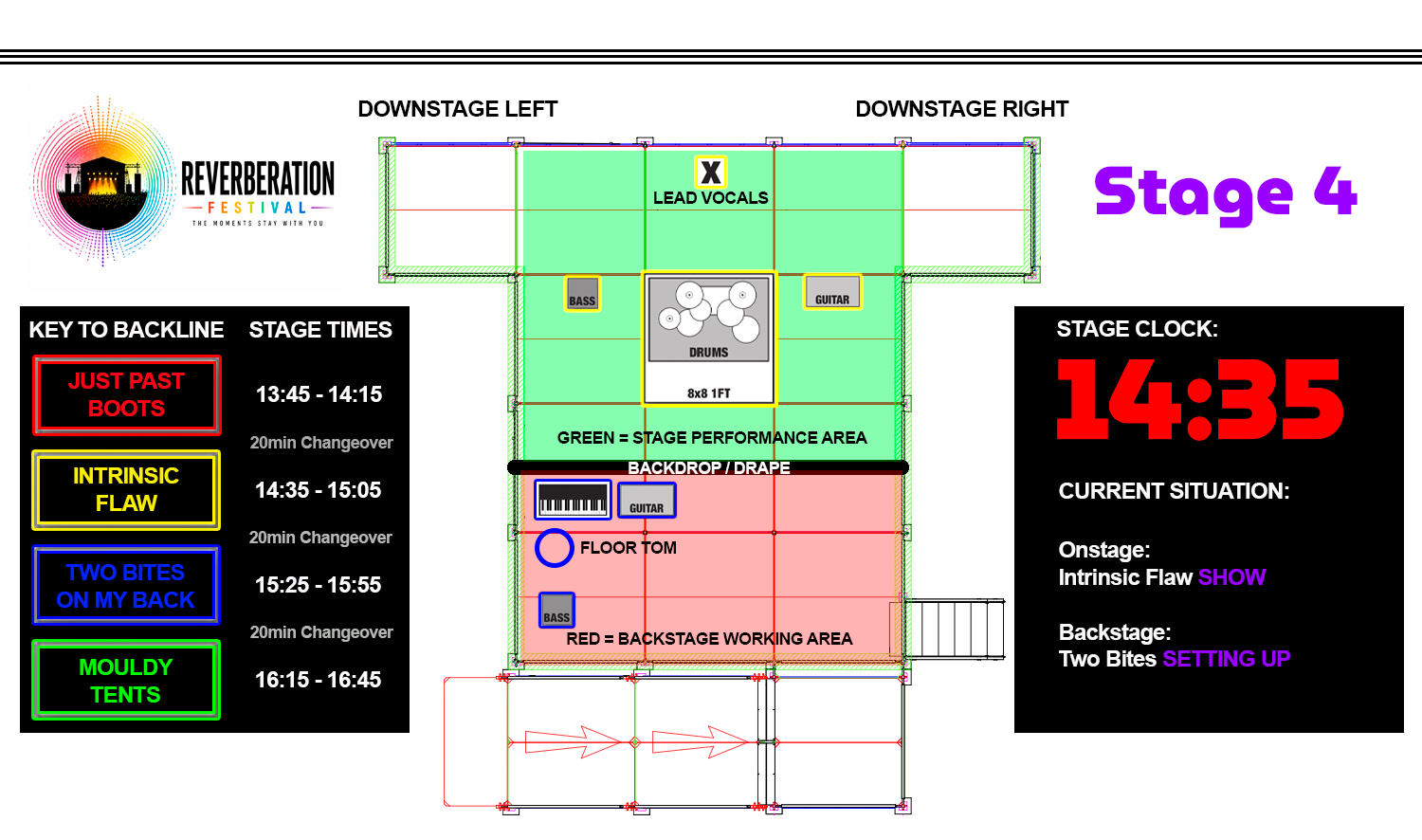
It’s 15:00, and they finish 5mins early, a gift to the Stage Manager, due to the excitement level being at maximum, the band didn’t do much talking in-between songs, and the set played much faster than they’d rehearsed. The dust in the air from the dry ground and the humidity inside the tent testament to how much the revellers enjoyed the show.
The lead singer leaves the stage, grabbing his girlfriend in one arm, and glugging the last of the warm beer from the bottle in the other, and heads into the welcoming Jack Saunders gaggle backstage.
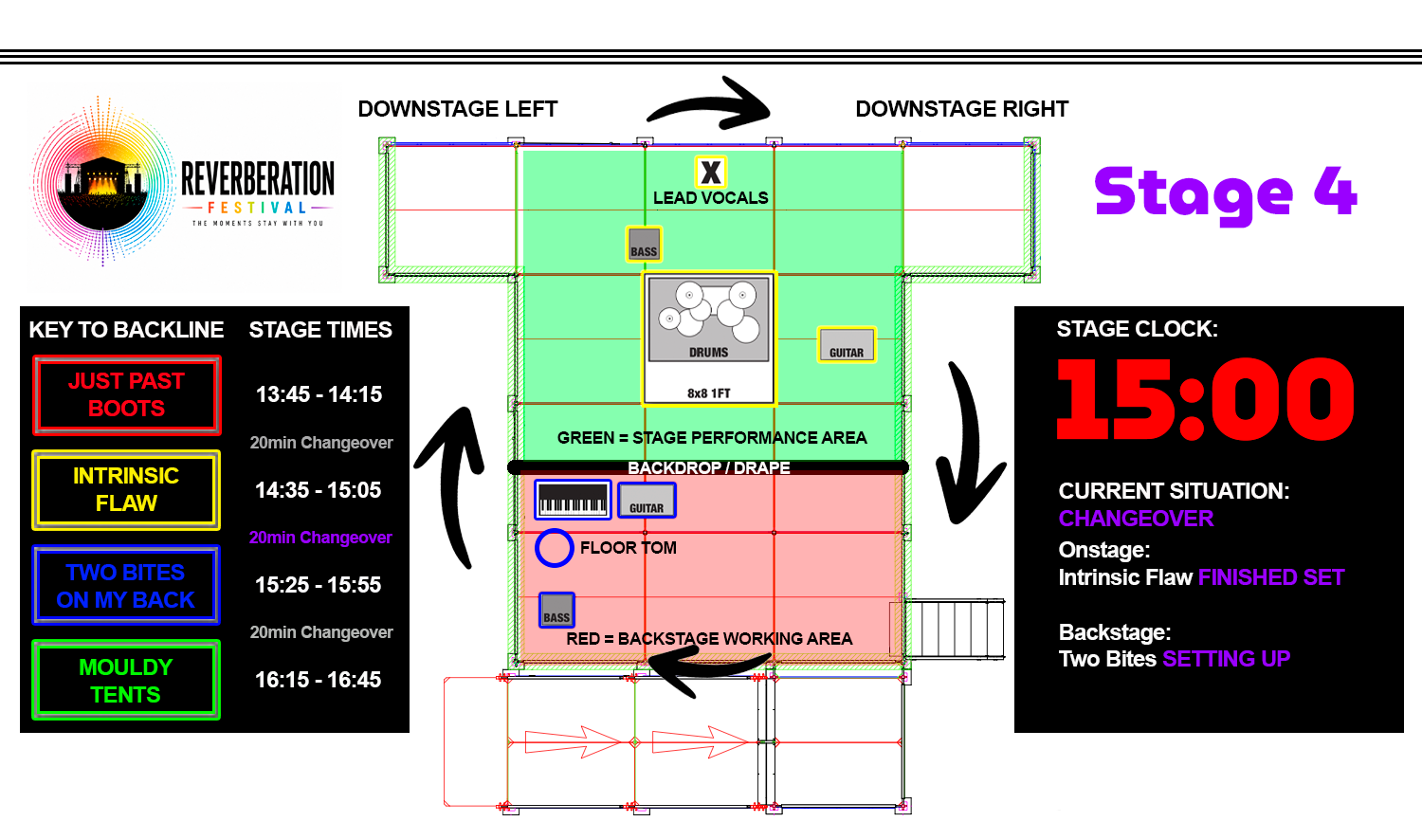
The stage crew are back to help, whilst Dan the driver and the drummer remove their cymbals. The Bass player struggles with the heavy Ampeg head with a member of the stage crew, and the guitarist coils up the bunting whilst the bedsheet backdrop is lowered.
At the same time, Two Bites start bringing their stuff out for their 20min changeover with an added 5mins gratefully received from Intrinsic Flaw finishing early. The irritating lead-singer-floor-tom, taking pride of place, helped and watched by the stage crew, audio team and stage manager.
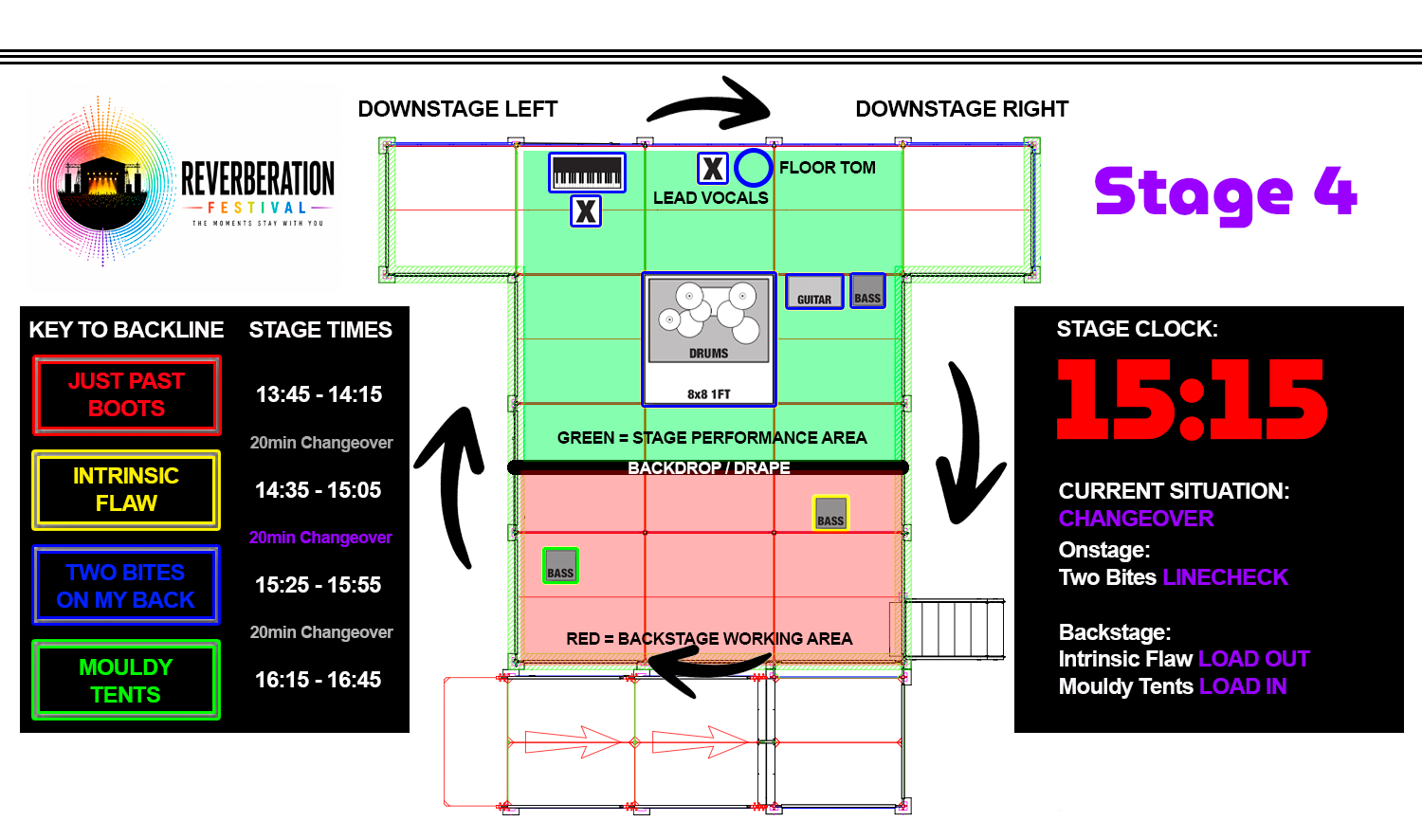
Dan the driver and the band, minus the lead singer and the girlfriend, pack everything up and stick it back in the van, and head back to the mouldy temporary building site office/dressing room, which they have for another 10mins before it’s needed for another band later on the line-up. Lucky, lucky bastards…
The Lead Singer finally appears, empty bottle of lager in his hand, gushing with enthusiasm about what Jack Saunders thought of them, and that he also met someone called a plugger, who will help them get their stuff played on the radio, as well as letting other industry folks know about them.
The 6 of them head off to the guest area to party, celebrating their success, convinced that they’ve actually made it.
Maybe they have. What they don’t realise yet is that every step up the festival ladder means more gear, more people, the same space & time issues and a lot more pressure.
Next year, they won’t be on stage four anymore, and that’s where changeovers start getting really complicated...
See also: